
Mini Split Installation in Kenosha, WI
A new system here will heat from October through May and cool from June through August every year. Tell us about the house, and a licensed contractor who covers Kenosha County will get in touch.
Tell us about the job
It takes about a minute.
What Kenosha winters ask of a mini-split
Your mini-split needs to work here 11 months of the year, heat from October through May and cooling through the summer. Winter nights average 18°F, cold enough that the heat pump has to keep pulling warmth from outside air night after night for a full eight-month stretch. Any new system installed today has to meet 14.3 SEER2 for cooling and 7.5 HSPF2 for heating, the federal minimum for this kind of unit.
Kenosha County also sees its share of winter storms and damaging wind, and close to a fifth of Wisconsin households lost power for a day or more last year. A mini-split needs power to run, so if backup power matters to your household, that's worth raising with the installer before the unit goes in.
- 8 months
- October through May, your system heats
- 3 months
- June through August, it cools
- 18°F
- the average winter night it heats against
- 80°F
- the average summer afternoon it cools against
NOAA nClimDiv, 1991–2020 normals
Wisconsin requires contractors to register with the state.
That registration puts the business on file with the Department of Safety and Professional Services. There is no trade exam behind it, and no state record of how the contractor's work has held up. Wisconsin also does not let counties or cities layer their own HVAC license on top of that, so this business record is the only state credential tied to the contractor, wherever in the county the job is.
For a mini-split installation, the protection that matters comes from the local building office instead. In most cities and counties, this kind of installation needs a permit and an inspection once the work is done, and that inspection is what checks the line set, the mounting, and the wiring between the indoor and outdoor units.
Sources: Wisconsin Legislative Reference Bureau · Wisconsin Department of Safety and Professional Services
- Is a mini split worth it?
- For most homes here, yes, especially in a room that gas heat does not reach well or a space you use enough to want steady control over. Kenosha winters push down to 18 degrees on average through December, January and February, so any heat pump you choose needs to be rated for real cold, not mild weather. A mini split also gives you cooling for the three summer months without adding ductwork. Whether it makes sense for your whole house or just one part of it depends on your layout, and a contractor can walk that with you.
- How many rooms can a mini split cover?
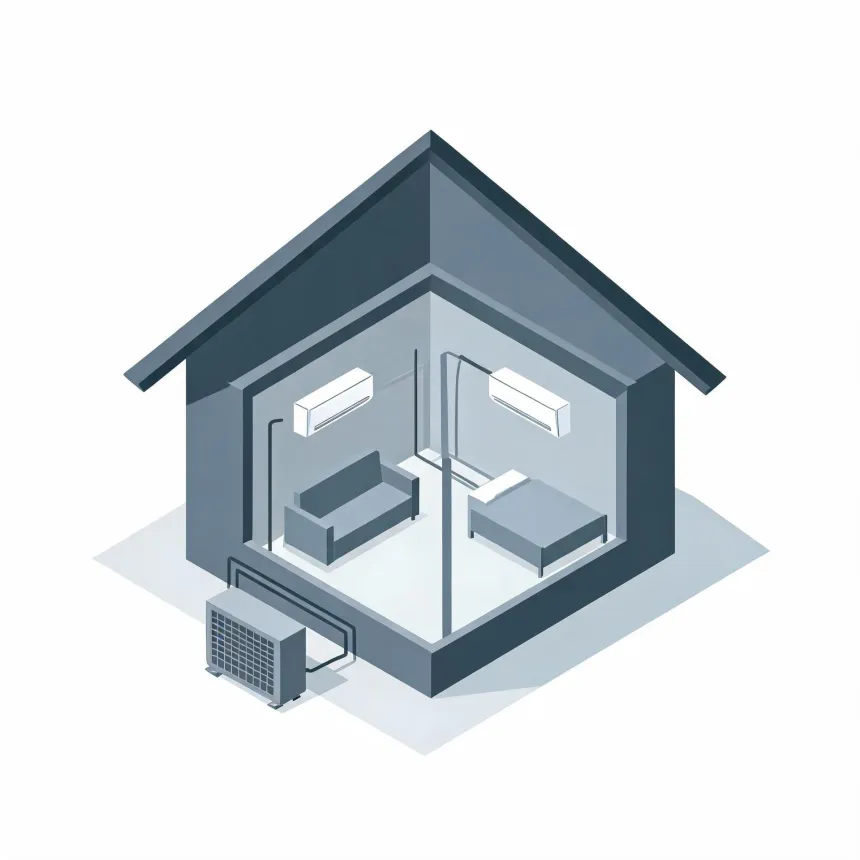
- A single indoor unit heats and cools the room it's in, plus maybe an open area right next to it. If you want separate rooms with doors between them handled well, you need either one indoor unit per room or a multi-zone system, where one outdoor unit runs several indoor heads. Multi-zone systems usually cover two to eight zones depending on the outdoor unit's capacity. A contractor can size it once they know how many rooms and how large each one is.
- Can a mini split heat a whole house?
- It can, but it depends on the system and the house. A multi-zone mini split with enough indoor units, one per room or area, can heat an entire home the same way a furnace does, and cold-climate models are built to keep working well below freezing. Kenosha winter nights average 18 degrees, so the unit needs a rating that holds up at that temperature. Most homes here already heat with gas, so a whole-house mini split is more often a choice you're making on purpose than a replacement forced by a broken furnace. A contractor can tell you what capacity and how many zones your house needs.