Mini Split Installation in Sheboygan, WI
A new system here will heat from September through May and cool from July through August every year. Tell us about the house, and a licensed contractor who covers Sheboygan County will get in touch.
Tell us about the job
It takes about a minute.
A mini-split here works nine months a year, sometimes more
Sheboygan County asks a lot of a mini-split. Winter nights average 15°F from December through February, and the system has to hold heat against that for the full stretch from September through May. Summer only asks two months of it, July and August, with afternoons around 78°F. Add it up and a mini-split here is doing one job or the other 11 months a year.
A unit built for this needs to perform at that low end, not just handle a mild fall evening. Any mini-split installed new has to meet the federal minimum, 14.3 SEER2 for cooling and 7.5 HSPF2 for heating, since it counts as a split-system heat pump under the standard. Worth asking about backup heat too. This county has seen 19 winter storms over the past ten years, and 18% of Wisconsin households went at least 24 hours without power in 2024.
- 9 months
- September through May, your system heats
- 2 months
- July through August, it cools
- 15°F
- the average winter night it heats against
- 78°F
- the average summer afternoon it cools against
NOAA nClimDiv, 1991–2020 normals
Wisconsin requires contractors to register with the state.
That registration puts the business on file with the Department of Safety and Professional Services. Nobody tested the contractor's trade knowledge to get it, and there is no state license behind it. Sheboygan County and its cities are not allowed to layer on their own HVAC license either, so this registration is the only state record that exists on a contractor doing this job.
For a mini-split installation, the protection comes from the local side instead. In most cities and counties, installing a mini-split needs a permit from the building office and an inspection once the work is done, and that inspection is where someone actually checks what was installed.
Sources: Wisconsin Legislative Reference Bureau · Wisconsin Department of Safety and Professional Services
- Is a mini split worth it?
- For a lot of homes here, yes. A mini split gives you heat when it's 15 below zero out and cooling in July and August without any ductwork to install or lose air through. It also lets you heat or cool just the room you're using, so a bedroom addition or a finished basement that the main system never reached gets handled on its own thermostat. Most homes here run on gas heat, and a mini split doesn't have to replace that. It can just cover the rooms your furnace struggles with.
- How many rooms can a mini split cover?
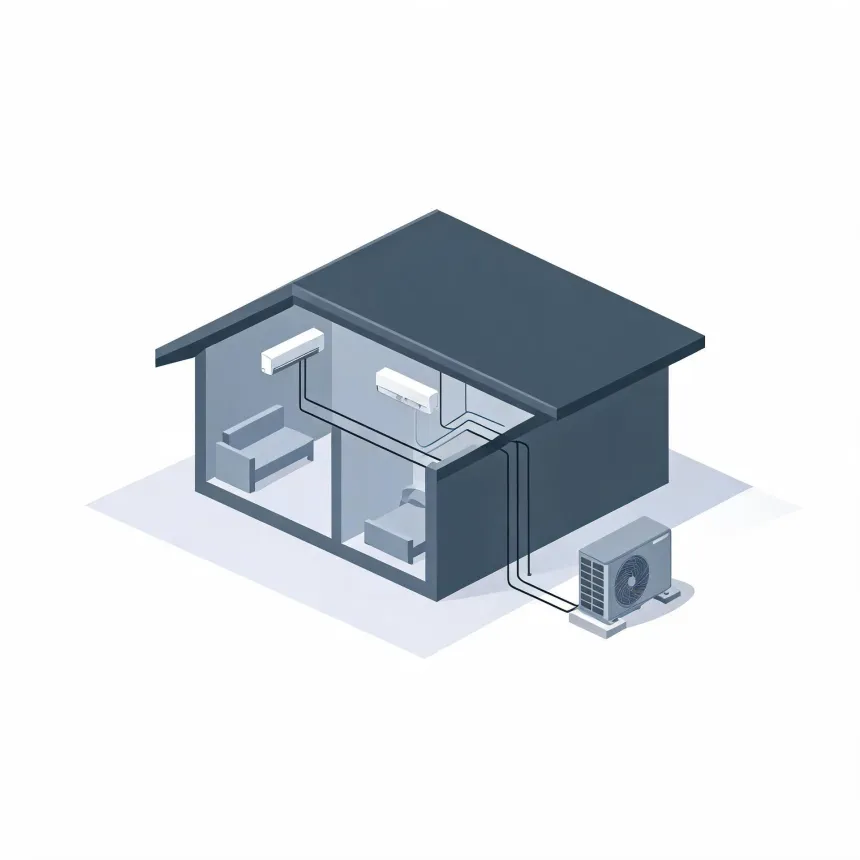
- That depends on the system a contractor puts in. One outdoor unit can run more than one indoor head, and each head is sized for the room it's in, so a contractor will look at the square footage and layout of every room before saying how many you need. Get the sizing wrong and a room either won't hold temperature or the unit will short cycle, so this is worth having measured rather than guessed at.
- Can a mini split heat a whole house?
- It can, if it's sized and placed for that from the start. A whole-house setup means either enough indoor heads to reach every room or a ducted mini split system that distributes air the way a furnace does. With winter lows around 15°F here, the heat pump has to be rated to keep up in that cold, not just on a mild day. A contractor can look at your house and tell you what that takes.